Esophageal Cancer Treatment in China
China has more esophageal cancer than any other country: about 224,000 of the 511,000 new cases worldwide in 2022, or roughly 44% [1]. Worldwide, about 90% of esophageal cancers are squamous cell carcinoma, and most cases in China are of this type [14]. Chinese teams have led several practice-changing phase III trials. NEOCRTEC5010, led by Sun Yat-sen University Cancer Center, showed that chemoradiotherapy before surgery clearly improves long-term survival for locally advanced disease [2] [3], and other trials showed that PD-1 immunotherapy with chemotherapy extends survival in advanced disease [4–8]. We can send your records to Prof. Jian-Hua Fu of the hospital's thoracic oncology department, get you a written treatment opinion, and arrange treatment in China if you decide to come.
- Specialists
- Prof. Jian-Hua Fu
- Typical time in China
- About 3–4 weeks for surgery alone; about 3 months for chemoradiotherapy followed by surgery
- Written opinion
- US$199, within 5 working days, with a cost estimate
Why patients consider China for esophageal cancer
1. The world's largest number of cases
China accounts for about 44% of new esophageal cancer cases worldwide [1]. Sun Yat-sen University Cancer Center has a dedicated thoracic oncology department, and Prof. Jian-Hua Fu directs the Guangdong Esophageal Cancer Institute [9].
2. Several treatment standards come from Chinese trials
| Setting | Trial led by Chinese teams | Result |
|---|---|---|
| Locally advanced, operable: chemoradiotherapy before surgery | NEOCRTEC5010, phase III, 451 patients, led by Sun Yat-sen University Cancer Center; Journal of Clinical Oncology 2018 [2] and JAMA Surgery 2021 [3] | Median overall survival 100.1 vs 66.5 months; 5-year survival 59.9% vs 49.1%; 43.2% of patients had no remaining cancer in the surgical specimen |
| Advanced, first line: chemotherapy plus immunotherapy | Camrelizumab (ESCORT-1st), 596 patients, JAMA 2021 [4] | Median overall survival 15.3 vs 12.0 months |
| Advanced, first line: chemotherapy plus immunotherapy | Toripalimab (JUPITER-06), 514 patients, Cancer Cell 2022 [5] | Risk of progression and risk of death each reduced by about 42% |
| Advanced, first line: chemotherapy plus immunotherapy | Sintilimab (ORIENT-15), 659 patients, BMJ 2022 [6] | Median overall survival 16.7 vs 12.5 months |
| Advanced, first line: chemotherapy plus immunotherapy | Tislelizumab (RATIONALE-306), global phase III, 649 patients, Lancet Oncology 2023 [7] | Median overall survival 17.2 vs 10.6 months |
| Advanced, second line: immunotherapy vs chemotherapy | Tislelizumab (RATIONALE-302), 512 patients in 11 countries and regions, Journal of Clinical Oncology 2022 [8] | Median overall survival 8.6 vs 6.3 months |
In March 2024, the US FDA approved tislelizumab for second-line treatment of advanced esophageal squamous cell carcinoma in patients who had not received a PD-1 or PD-L1 inhibitor, based on RATIONALE-302 [10]. More on Chinese PD-1 drugs and their prices: cancer immunotherapy in China.
3. Dedicated services for international patients
The hospital's International Medical Center has its own area; outpatients can book a named specialist, and inpatient care is led by an attending professor with a multidisciplinary team [11].
Treatment options by stage
Your plan is decided by the doctor after reviewing your pathology, CT or PET-CT and endoscopy results. The table shows common approaches.
| Stage | Common treatment | Treatment length | Approximate stay in China |
|---|---|---|---|
| Very early (limited to the lining) | Endoscopic submucosal dissection [15] | A few days in hospital | About 1–2 weeks |
| Early (not through the esophageal wall, no lymph nodes) | Esophagectomy, often minimally invasive [16] | About 2 weeks in hospital after surgery | About 3–4 weeks |
| Locally advanced, operable | Neoadjuvant chemoradiotherapy (in NEOCRTEC5010: vinorelbine plus cisplatin for 2 cycles with 40 Gy of radiotherapy in 20 sessions), then esophagectomy [2] | Chemoradiotherapy about 4 weeks (5 days a week [2]), then surgery after a recovery interval of several weeks | About 3 months |
| Locally advanced, not operable | Definitive chemoradiotherapy | About 6 weeks | About 2 months |
| Advanced or metastatic, first line | PD-1 immunotherapy with chemotherapy, for example every 3 weeks for up to 6 cycles, then immunotherapy maintenance [5] | Chemotherapy phase about 4–5 months | First cycles in China; whether later treatment can continue at home is decided by the doctor |
| Advanced or metastatic, second line | Tislelizumab for patients who have not received a PD-1 inhibitor [8] | Depends on the plan | Depends on the plan |
Stays and times in China are typical estimates. Your written opinion gives the plan for your case.
Specialist we can connect you with
This specialist can provide a written opinion or an outpatient appointment through us. This page was written by our medical team based on published research.
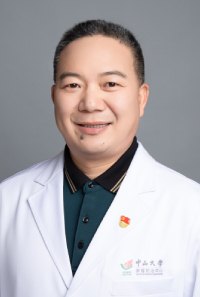
Prof. Jian-Hua Fu
Professor of Thoracic Oncology; Director, Guangdong Esophageal Cancer Institute · Department of Thoracic Oncology, Sun Yat-sen University Cancer Center
Surgery and multimodality treatment of esophageal cancer
- JAMA Surgery 2021 (senior author): Long-term Efficacy of Neoadjuvant Chemoradiotherapy Plus Surgery for the Treatment of Locally Advanced Esophageal Squamous Cell Carcinoma: The NEOCRTEC5010 Randomized Clinical Trial — PubMed 34160577
- Radiotherapy and Oncology 2021 (senior author): Computed tomography-based deep-learning prediction of neoadjuvant chemoradiotherapy treatment response in esophageal squamous cell carcinoma — PubMed 32941954
- Journal of Thoracic Oncology 2016 (senior author): Identification and Validation of Lymphovascular Invasion as a Prognostic and Staging Factor in Node-Negative Esophageal Squamous Cell Carcinoma — PubMed 26792626
Hospital: Sun Yat-sen University Cancer Center
- Founded in 1964 in Guangzhou; a Grade A tertiary cancer hospital.
- Ranked in the top five for oncology in the China Hospital Specialty Reputation Ranking (2023) by Fudan University's Hospital Management Institute [12].
- Has a thoracic oncology department, the Guangdong Esophageal Cancer Institute, and an International Medical Center [9] [11].
- Listed among Guangdong's first pilot hospitals for international medical services in 2026 [13].
Costs
Your personal cost estimate is included in the specialist's written opinion.
| Item | China (SYSUCC International Medical Center) |
|---|---|
| Specialist's written opinion | US$199 |
| First visit, endoscopic resection, chemoradiotherapy, esophagectomy | Quoted individually in your cost estimate |
| PD-1 immunotherapy (per cycle) | See Chinese PD-1 drug prices |
| Accommodation near the hospital (28 nights) | Apartment-style room with fridge and washing machine: mostly US$750–1,000. Hotel room: US$1,400–2,250. |
| Food, local transport and other living costs (per person, per month) | About US$550–600 (around RMB 4,000) |
Accommodation: Trip.com prices for rooms within about 400 m of SYSUCC, 28 nights from 7 December 2026, checked on 12 November 2026, including taxes and the discounts shown at the time. Prices change with dates and season. Living costs: Numbeo, November 2026. More on accommodation.
From first contact to starting treatment
- Send your records
Pathology report, CT or PET-CT images (DICOM), endoscopy and endoscopic ultrasound reports, treatment history. Same day - Initial review
A medical coordinator checks and translates your records. Within 24 hours - Specialist's written opinion
Recommended treatment and a cost estimate. Within 5 working days of receiving your complete records - Travel arrangements
Appointment, hospital invitation letter, visa support, accommodation and airport pickup. - Hospital visit
Consultation at SYSUCC, with additional tests if needed. - Treatment starts
A coordinator and interpreter support you throughout.
Frequently asked questions
Can esophageal cancer be cured?
Early-stage esophageal cancer can often be treated effectively. In a Shanghai cohort of 596 patients with T1 squamous cell carcinoma, overall survival was similar after endoscopic submucosal dissection and after esophagectomy, with fewer serious complications after endoscopic treatment [15]. For locally advanced disease treated with chemoradiotherapy followed by surgery, the NEOCRTEC5010 trial reported a 5-year survival rate of 59.9% [3]. Trial participants are selected, so your outlook depends on your stage and health; the specialist will explain this in the written opinion.
How long will I need to stay in China?
Chemoradiotherapy followed by surgery usually takes about three months. Surgery alone usually takes about three to four weeks, including recovery in hospital. These are typical estimates; your written opinion gives the plan for your case.
Will I be able to eat normally after surgery?
After an esophagectomy, the stomach is usually used to replace the removed esophagus. Most patients can eat again, but need smaller, more frequent meals. In a Chinese randomised trial of 280 patients, starting to eat on the first day after minimally invasive surgery did not increase complications and patients recovered bowel function sooner [16].
Is minimally invasive surgery available?
Yes. Minimally invasive (thoracoscopic and laparoscopic) esophagectomy is widely used at major Chinese centres and has been studied in Chinese randomised trials [16]. Prof. Fu can advise whether it suits your case.
I do not speak Chinese. How will I communicate?
Our medical coordinators work with you in English (or Russian) throughout, and an interpreter accompanies you to appointments. The hospital's International Medical Center also has a team for international patients [11].
Can my family come with me?
Yes. We help you and your family find accommodation near the hospital.
How do I pay? Can I use insurance?
Hospitals accept self-payment. Some international departments in China also accept commercial insurance; whether your insurer can settle bills directly depends on your policy, and we check this with the hospital before you travel.
How is follow-up done after I return home?
Follow-up usually includes regular CT scans and endoscopy, more often in the first two years; your doctor sets the schedule. We arrange remote follow-up consultations and translate your reports.
Can I get a specialist opinion without travelling to China first?
Yes. Upload your records and the specialist will give a written opinion. You can then decide whether to come to China.
Leading hospitals and specialists for esophageal cancer in China
From our directory of leading Chinese hospitals: where senior specialists list esophageal cancer as a clinical focus, sorted by their first- or senior-author papers on it since 2016. This is not a quality ranking. How we build this directory
Senior specialists in our directory
Prof. Kuaile Zhao(FUSCC) · Prof. Yin Li(CHCAMS) · Dr. Feng Wang(Fujian Cancer Hospital) · Prof. Mian Xi(SYSUCC) · Prof. Jiancheng Li(Fujian Cancer Hospital) · Dr. Guiqi Wang(CHCAMS) · Dr. Qixun Chen(Zhejiang Cancer Hospital) · Prof. Zhouguang Hui(CHCAMS) · Dr. Hong Ge(Henan Cancer Hospital) · Dr. Wencheng Zhang(TMUCIH) · Dr. Linlin Wang(Shandong Cancer Hospital) · Prof. Zhihao Lu(Peking University Cancer Hospital)
We have not necessarily worked with these doctors. Specialists we can connect you with are listed above.
Get a specialist's written opinion
Upload your pathology report and imaging. A medical coordinator will reply within 24 hours and pass your records to Prof. Jian-Hua Fu.
Start hereReferences
- Qi et al. Chinese Medical Journal, 2024 (GLOBOCAN 2022 esophageal cancer: 511,054 new cases worldwide; 224,012 in China, 43.8%). https://doi.org/10.1097/CM9.0000000000003420
- Yang H, et al. Neoadjuvant chemoradiotherapy followed by surgery versus surgery alone for locally advanced squamous cell carcinoma of the esophagus (NEOCRTEC5010). J Clin Oncol. 2018. PMID 30089078. https://pubmed.ncbi.nlm.nih.gov/30089078/
- Yang H, et al. Long-term efficacy of neoadjuvant chemoradiotherapy plus surgery for locally advanced esophageal squamous cell carcinoma: the NEOCRTEC5010 randomized clinical trial. JAMA Surg. 2021. PMID 34160577. https://pubmed.ncbi.nlm.nih.gov/34160577/
- Luo H, et al. Camrelizumab vs placebo added to chemotherapy in advanced or metastatic esophageal squamous cell carcinoma (ESCORT-1st). JAMA. 2021. PMID 34519801. https://pubmed.ncbi.nlm.nih.gov/34519801/
- Wang ZX, et al. Toripalimab plus chemotherapy in treatment-naive, advanced esophageal squamous cell carcinoma (JUPITER-06). Cancer Cell. 2022. PMID 35245446. https://pubmed.ncbi.nlm.nih.gov/35245446/
- Lu Z, et al. Sintilimab versus placebo in combination with chemotherapy as first line treatment for oesophageal squamous cell carcinoma (ORIENT-15). BMJ. 2022. PMID 35440464. https://pubmed.ncbi.nlm.nih.gov/35440464/
- Xu J, et al. Tislelizumab plus chemotherapy versus placebo plus chemotherapy as first-line treatment for oesophageal squamous cell carcinoma (RATIONALE-306). Lancet Oncol. 2023. PMID 37080222. https://pubmed.ncbi.nlm.nih.gov/37080222/
- Shen L, et al. Tislelizumab versus chemotherapy as second-line treatment for esophageal squamous cell carcinoma (RATIONALE-302). J Clin Oncol. 2022. PMID 35442766. https://pubmed.ncbi.nlm.nih.gov/35442766/
- Sun Yat-sen University Cancer Center. Department of Thoracic Oncology — specialists. https://english.sysucc.org.cn/list_26.aspx?lcid=101
- The ASCO Post. FDA approves tislelizumab for previously treated patients with advanced esophageal cancer (March 2024). https://ascopost.com/news/march-2024/fda-approves-tislelizumab-for-previously-treated-patients-with-advanced-esophageal-cancer
- Sun Yat-sen University Cancer Center. International Medical Center. https://english.sysucc.org.cn/index_79.aspx
- Fudan University Hospital Management Institute, China Hospital Specialty Reputation Ranking 2023 (oncology), as reported by The Paper. https://www.thepaper.cn/newsDetail_forward_25427491
- Report on Guangdong international medical service pilot hospitals (March 2026). https://huacheng.gz-cmc.com/pages/2026/03/27/df7448fe8b724aad84d266c2b0fe77db.html
- Abnet CC, Arnold M, Wei WQ. Epidemiology of esophageal squamous cell carcinoma. Gastroenterology. 2018. PMID 28823862. https://pubmed.ncbi.nlm.nih.gov/28823862/
- Zhang Y, et al. Outcomes of endoscopic submucosal dissection vs esophagectomy for T1 esophageal squamous cell carcinoma in a real-world cohort. Clin Gastroenterol Hepatol. 2019. PMID 29704682. https://pubmed.ncbi.nlm.nih.gov/29704682/
- Sun HB, et al. Early oral feeding following McKeown minimally invasive esophagectomy: an open-label, randomized, controlled, noninferiority trial. Ann Surg. 2018. PMID 28549015. https://pubmed.ncbi.nlm.nih.gov/28549015/